At the end of this piece we explain the core inspiration behind HunchLog. The macro analysis runs first.
The advice that defined a generation of retail investing (buy SPY, ignore the news, let two decades compound) was never timeless. It worked because four specific things were simultaneously true between roughly 2010 and 2021. Globalisation was still deepening. Real interest rates sat near zero or below. Dollar hegemony was unchallenged. And US large-cap technology was, by global consensus, the world's default risk asset.
A reader in 2026 can quietly check those four claims against today's tape and notice that none of them hold in the same form. That doesn't mean the index is dead. It means the recommendation was always conditional, the conditions have moved, and a thoughtful investor has to do work that didn't used to be necessary.
The preconditions are gone
The 10-year TIPS yield closed yesterday at 1.91%, a level the post-GFC orthodoxy treated as restrictive enough to break things. For comparison, the 2010–2021 average lived close to zero, dipping deeply negative through 2020–2021. Discount-rate maths that worked when the real rate was -50bp doesn't work the same way at +191bp; it's the single biggest mechanical reason multiples on long-duration tech have to compress, even if revenue holds.
The dollar story is more fragile than the headline DXY suggests. The index sits at 98.66, off its April high of 99.18 and weaker by about 1.8% on the month. The level is unremarkable. The narrative around it isn't. Ray Dalio's reading (that gold has now become the world's second reserve currency, behind the dollar) would have been fringe in 2018 and is now mainstream enough to surface in a tweet thread that gets a hundred thousand views. The April 2026 World Gold Council flow report shows the regional split clearly: Western outflows, Asian inflows, with the rotation tilted toward China and India. That's not a panic. It's a reallocation by sovereigns and large allocators who treated dollar reserves as a constant for forty years.
Tariffs have stopped being a 2025 event and become a 2026 fact. A year on from the original "Liberation Day" announcement, Axios's one-year retrospective catalogues the measurable damage: roughly 100,000 manufacturing jobs lost between January 2025 and April 2026, the goods deficit at an all-time high, the agricultural trade deficit out by 10.8%. The Supreme Court ruling in Learning Resources, Inc. v. Trump declared the IEEPA tariff use illegal and triggered ~$166bn in pending refunds, but the executive branch promptly responded by proclaiming new tariffs on patented pharmaceuticals on April 2. The regime survives by mutating. Pricing globalisation as monotonically deepening (the implicit assumption inside any 2015-vintage SPY thesis) is no longer defensible.
The fourth precondition was that US large-cap tech would absorb the world's risk capital indefinitely. That's where it gets interesting, because the most concentrated bet in retail finance lives inside the index everyone calls passive.
The hidden active bet inside the passive vehicle
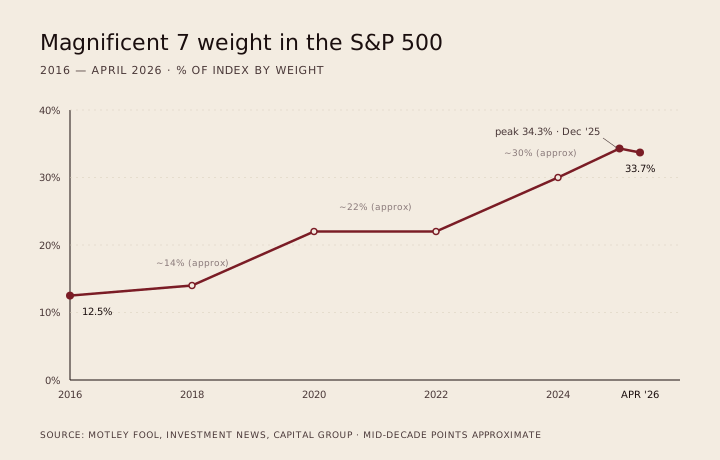
Apple, Microsoft, Nvidia, Alphabet, Amazon, Meta, and Tesla (the Magnificent Seven) are roughly 1.6% of the index's stock count and 33.7% of its weight as of mid-April 2026. In December 2025 the figure was 34.3%. In 2016 it was 12.5%. Motley Fool's January piece captures the consensus framing for 2026: this concentration isn't an anomaly any more, it's the dominant structural feature of the index. Add Communication Services to Information Technology and you reach roughly 46% of the S&P 500 in two sectors that share most of the same economic exposures: cloud, advertising, semiconductors, hyperscaler capex.
When you buy SPY, you are buying that mix, by weight, on auto-pilot. Mike Green has spent years arguing that this isn't a neutral act because the marginal flow into broad-market funds is itself the price-setter: a mechanism that doesn't care about valuation, doesn't care about earnings, and gets disproportionately allocated to whatever is already biggest. His recent commentary on Hussman's bubble note lays out the structural argument cleanly. Whether you find Green fully persuasive or only partly, the load-bearing point is mechanical: a "neutral" index allocation is, in 2026, a very large active bet on seven correlated mega-caps.
The bet has started to misfire. Bloomberg reported on March 22 that the correlation between the Mag 7 and the equal-weight S&P turned negative on February 23, for the first time in years. Through the third quarter of 2025, non-Mag 7 names had already done 59% of the index's YTD return. The macro environment most punishing to long-duration tech is also the one in which AI capex is peaking: hyperscaler 2026 capital spending is tracking near $700bn, roughly three-quarters of it tied directly to AI infrastructure. CNBC's February analysis notes Amazon is projected to turn negative on free cash flow this year, and Barclays models a near-90% drop in Meta's FCF at the top end of guidance. The trade everyone is implicitly making through their 401(k) is Mag 7 will earn its way through the capex spike before the market loses patience.
That trade may pay off. It is not, in any honest accounting, a passive trade.
People are already deviating, they just aren't admitting it
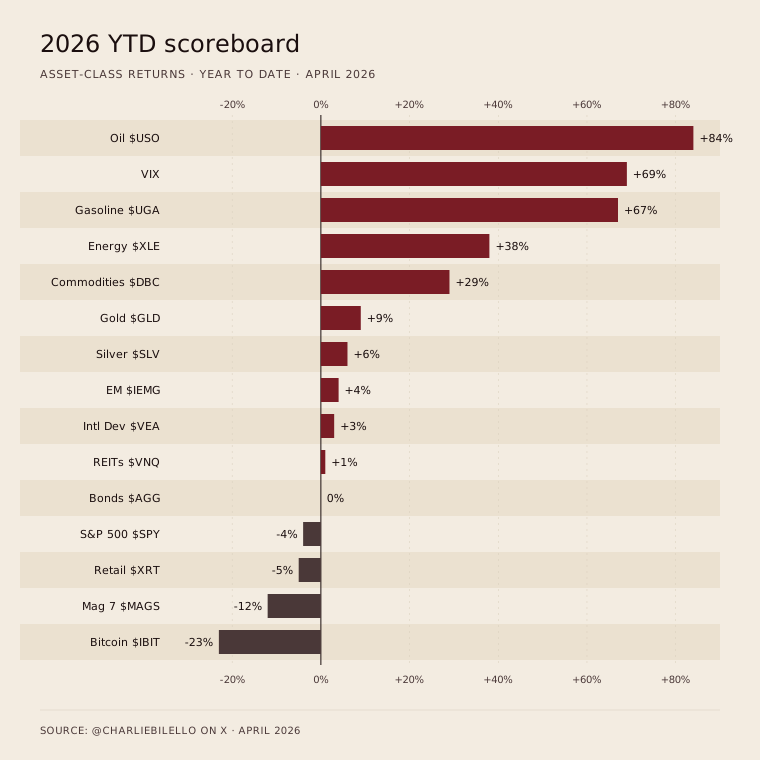
The clearest snapshot of the regime shift comes from Charlie Bilello's weekly asset-class tracking, which summarised 2026 YTD performance as: oil up 84%, gasoline up 67%, energy up 38%, commodities up 29%, gold up 9%; the S&P down 4%, retail down 5%, the Mag 7 down 12%, bitcoin down 23%. This is what a regime change looks like in price. It also explains why retail flow data has gone the way it has.
January 2026 set the all-time monthly record for international ETF inflows at $51bn, with international flows topping US equity flows for the first time since early 2023. iShares' Q1 2026 flow report puts intl/EM at roughly half of all equity inflows YTD, against about 20% the year before. Defense thematics took in a record monthly $3bn in March; SHLD added $1bn in January alone and is up 20% YTD. Gold ETFs took $18.7bn in January (an all-time record), then bled $12bn in March; the World Gold Council's report makes clear that was rotation, not exit, since Asia added $14bn YTD over the same window.
The AAII survey rounds out the picture. As of late April, bears outnumber bulls 42.8% to 31.7%, with bearishness running well above its long-run 30.5% average. Lorenzo Valente's chart of gold market cap as a percentage of US M2 hitting ~170% (a level seen only in 1934 and 1980) is a tail observation, but those two prior touches rhyme: regime shifts in the dollar system, not generic risk-off.
The composite signal is unambiguous. Retail and institutional money has already deviated from the post-2010 default. Some of those deviations will look prescient in five years; others will look like 2007-vintage gold bug positioning that missed a decade of equity returns. The trouble is that almost nobody is keeping a record of which of their own calls were which.
Active calls without a feedback loop are religion
The standard advice industry treats the choice as binary. Either hold the index passively or tilt actively, in which case you'd better have a process. In practice, almost every retail investor sits somewhere in the middle: holding mostly index, then layering on tactical bets: gold, BTC, defence stocks, international tilts, occasional single-stock conviction trades. They have a portfolio that looks 90% passive and behaves 60% active.
The honest question is whether those tactical layers add value. The honest answer, for almost everyone, is we don't know, because nobody is measuring. The brokerage statement collapses everything into a single P&L number that mixes the index return, the tilts, the contributions, the cash drag, and the timing. It tells you whether you made money. It does not tell you whether you have skill on tariffs, on AI capex inflection points, on dollar weakness, on commodity cycles, or whether the quarter's return came from the same boring index exposure you'd have held anyway.
A trader at a fund has to defend each thematic call individually, against a benchmark, in writing, on a desk where someone else can read it. A retail investor has none of that scaffolding. The result is a steady drift toward a portfolio of conviction trades with no audit trail behind any of them. Active calls without a feedback loop don't compound into skill; they compound into self-narrative.
What we built HunchLog for
This is the gap HunchLog was designed for. Log the deviation when you have it (the gold add, the energy tilt, the international rotation, the single-stock fade) with a one-line thesis and a conviction score, before you place the trade or decide not to. The app keeps the record. Quarterly, it tells you which categories of call have actually paid off, which haven't, and where you've been calibrated rather than merely lucky.
The point isn't to trade more. It's to find the one or two areas where your gut is genuinely producing edge in this regime, and to size those up, while sizing down the calls you keep losing on without realising it. Calibration over P&L. Validation over execution.
If 2010–2021 was the era when the right move was to do less, 2026 is the era when the right move is to do less, but measure everything you do anyway. The deviations from the index are happening with or without a record. A record is the only way to know if any of them deserve to keep happening.